
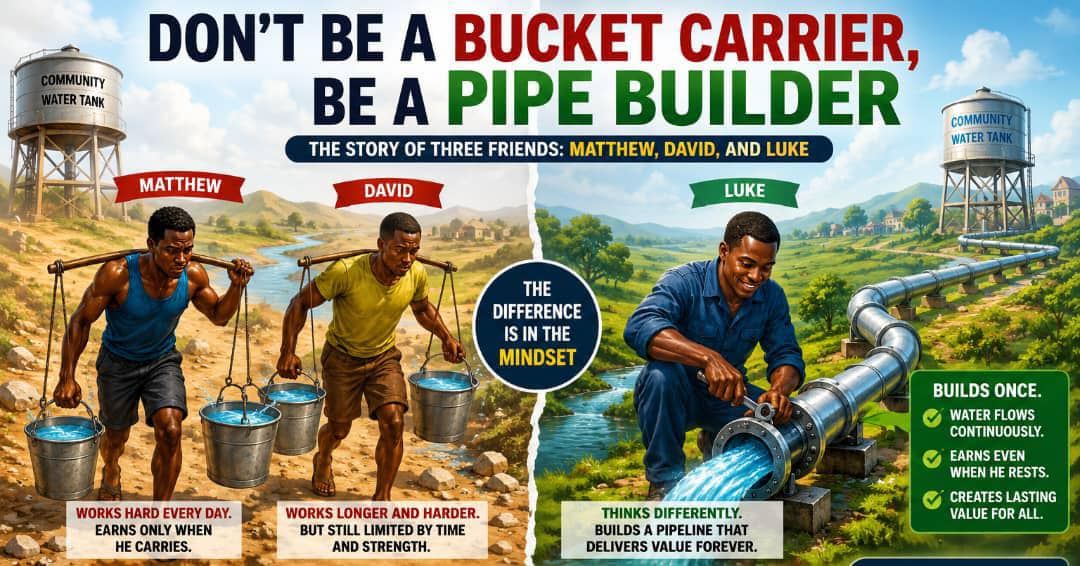
There were once three close friends named Matthew, David, and Luke who lived in a small community. Like many young people, they all wanted to become successful, financially independent, and respected in society. However, they had different ideas about how to achieve success.
One day, the leaders of their community announced an opportunity. The community needed people to supply water from a distant river to a large storage tank in the town. Anyone who could deliver water would be paid for every bucket supplied.
Matthew, David, and Luke immediately saw this as an opportunity.
Matthew the Hardworking Bucket Carrier
Matthew was very strong and hardworking. Every morning, he carried two large buckets to the river, filled them with water, and carried them back to the community.
The more buckets Matthew carried, the more money he earned.
He worked from morning until evening and soon became one of the best-paid workers in the community. Matthew was proud because he could see immediate results from his hard work.
However, there was a problem: if Matthew stopped working, the money stopped coming.
When he became sick, tired, or unable to carry buckets, he earned nothing. His income depended completely on his physical effort and time.
David Follows the Same Path
David also decided to become a bucket carrier. He saw Matthew making money and believed that working harder was the best way to become successful.
David bought bigger buckets and worked longer hours. Soon, he was earning more money.
However, after several years, David began to feel exhausted. He realized that no matter how much he worked, there was a limit to the number of buckets he could carry each day.
He began to wonder:
«"Will I still be carrying buckets for the rest of my life?"»
Luke Thinks Differently
Luke also started by carrying buckets, but he spent time thinking about the problem.
He asked himself:
"Why should we carry water every day when we can find a better way to move the water?"
While Matthew and David continued carrying buckets, Luke started working on a different idea: building a pipeline from the river directly to the community.
The project was not easy.
Luke had to spend time planning. He had to learn new skills, find materials, and work without receiving immediate rewards. Some people even laughed at him.
They said:
«"Why waste your time building pipes when you can make money carrying buckets?"»
But Luke continued.
The Pipeline Begins to Work
After months of hard work, Luke completed the first section of his pipeline.
Slowly, water began to flow through the pipes.
Luke continued improving and expanding the system until the water reached the community.
Now, while Matthew and David were still carrying heavy buckets every day, Luke's pipeline was delivering water automatically.
The community paid Luke for the water supply, and his system continued working even when he was resting, sleeping, or spending time with his family.
Luke had created something that could continue producing value beyond his daily physical effort.
The Lesson
The story of Matthew, David, and Luke teaches us an important lesson about life, business, and personal development.
A bucket carrier depends mainly on continuous personal effort. When the person stops working, the income or results may also stop.
A pipe builder thinks about creating systems, skills, businesses, products, and solutions that can continue producing value over time.
Being a pipe builder does not mean avoiding hard work. In fact, building a pipeline may require even more effort, patience, learning, and sacrifice in the beginning.
However, the difference is this:
A bucket carrier works in the system. A pipe builder works to build the system.
How Can You Become a Pipe Builder?
You can begin by asking yourself these questions:
- What problem can I solve permanently?
- What skill can I learn that will create long-term opportunities?
- Can I build a business instead of depending only on daily income?
- Can I create a system that serves people even when I am not physically present?
- Can technology help me automate part of my work?
- Can I teach others and build a team?
For example, instead of repairing only one smartphone at a time, you may build a repair business with trained technicians.
Instead of teaching only one student at a time, you can create training materials, online courses, or a learning platform that can serve many students.
Instead of depending only on manual work, you can use technology to build systems that make your work faster and more efficient.
Conclusion
Hard work is important, and there is nothing wrong with carrying buckets. Sometimes, carrying buckets is where we must begin.
But we should not stop there.
As we grow, we should learn to think beyond daily labour and begin building systems that create lasting value.
Do not spend your entire life only carrying buckets. Learn, plan, innovate, and build pipelines.
Because while a bucket must be carried again and again, a well-built pipeline can continue delivering value for many years.
Remember:
«Work hard, but also work wisely. Don't just carry the bucket—build the pipeline.»